
- Created By bellpickle
Ex-Wives and "Deadbeat Dads" in the Media
So I was reading this one creepypasta and the majority of the opening paragraph is:
I moved last year because I had divorced my wife and lost my old house along with custody of James. It’s rather the shit-end of the stick, but James and I love Halloween. It’s one of the few times a year that Tracy finds it acceptable for my only son to come visit me. James stays with her on every other holiday throughout the year, his birthday, and everything else in between. I get to see him only on my birthday and the week preceding Halloween, unless the high bitch-court finds it suitable for him to come spend the night every once in a while. Hmph. Frankly, I’m surprised she let him come shopping with me.
And I recalled that I have seen a LOT of movies that feature the whole "bitchy ex-wife who rarely lets me see my kids" trope. And it REALLY bugs me that the media so easily demonizes "ex-wives" in comparison to "ex-husbands." First of all, how often is it truly the case that the ex-husband (who does not have custody of the children) is a wonderful father who was equally involved in raising his children? Why should ex-husbands feel entitled to see their kids as often as they want when most fathers don't even ask for custody in the first place?
I think it's especially bad when movies/tv shows/etc. have their male lead character feel "threatened" when their ex-wife marries a wealthier man who is "stealing" his family from him. (And it's always a wealthier man because that just makes the ex-wife even more of a superficial bitch, right???) To re-iterate: most fathers don't even ask for custody in the first place. The media needs to stop sympathizing with deadbeat dads--if anything, the media should be criticizing the shit out of them and sympathizing more with single mothers.
EDIT: Ok I just came across this webpage and though it's not directly related to this post, it does relate to a lot of things I post more generally, so I'm just gonna lump it in here:
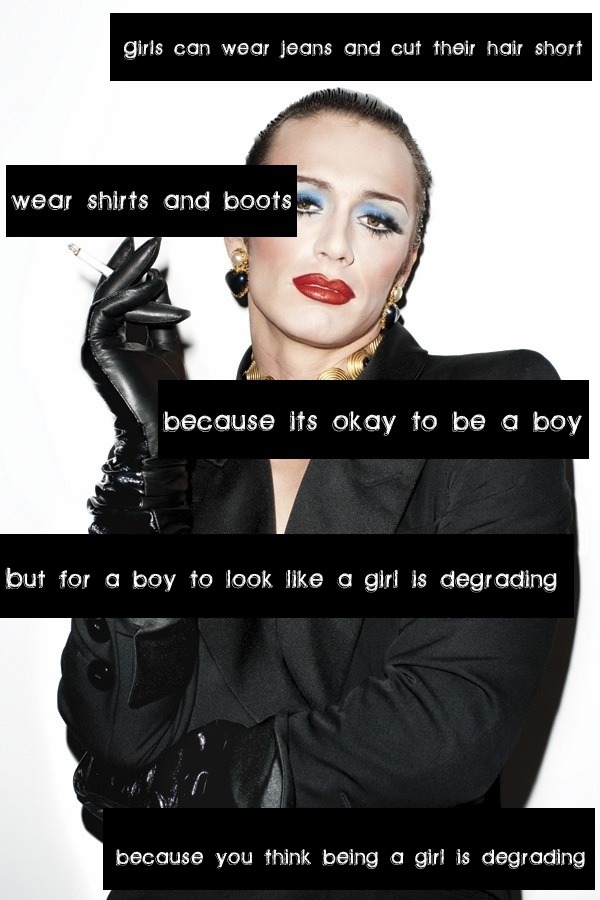
Androcentrism: It’s Okay to Be a Boy, but Being a Girl…
"Sociologists use the term “androcentrism” to refer to a new kind of sexism, one that replaces the favoring of men over women with the favoring of masculinity over femininity. According to the rules of androcentrism, men and women alike are rewarded, but only insofar as they are masculine (e.g., they play sports, drink whiskey, and are lawyers or surgeons w00t!). Meanwhile, men are punished for doing femininity and women… well, women are required to do femininity and simultaneously punished for it."
ParaNorman = Natsume Yuujinchou
Just finished watching the movie, and seriously. To anyone who has seen both, the parallels should be obvious.
And the climax of ParaNorman really explains why I love Natsume (the character) so much. Because even though he was bullied his whole life (and honestly, there's a strong likelihood that he was abused by some of his relatives), he made a conscious decision to not hate everybody and to try to see the good in others.
And I'll leave it at that, lest I go into fangirl mode. *-*
JJBA Voice Actors
On Twitter:
Sugita (Joseph): Fight by my side from now on too, Caesar!
Sato (Caesar): I’ll always be watching over you, JOJO.
In contrast, Phantom Blood actors in first meeting (as told on JOJOraDIO):
Okitsu (Jonathan): Oh, you must be the voice actor for Dio! Nice to meet you, Koyasu-sa
Koyasu (Dio): I’m not going to be friends with you.
Okitsu (Jonathan): Huh?
Koyasu (Dio): You’re Jonathan, right? I’m not going to be friends with you.
Okitsu (Jonathan): (´・ω・`)
koyasu pls
So I just got an offer of employment
As a fundraiser for a charity organization called Children International. (To clarify, I'm not employed under the organization itself, but a separate organization that fundraises for them. It's actually pretty interesting how different nonprofits get their funding, but tl;dr that's a post for another time.)
It's such a coincidence, since my best friend just got accepted to his first-choice graduate program, then a few days later, I get this job! And the salary + benefits are pretty good considering that I'll only be working 5 days/week. But most of all, it's such a relief to no longer have to worry about applying for jobs, relatives giving me not-so-great suggestions about what I should do/what types of jobs I should look for, scraping together the money to pay for my monthly loan repayments, etc.
AND I get 5 weeks paid vacation, which means I can take a trip abroad! Maybe I can visit all the Western European countries I didn't get to see this past summer. Or maybe I can finally GO TO JAPAN asdadjasjkdsj
In any case, I'm excited. Nervous too, because this job will require me to step outside my comfort zone (which is honestly part of the reason I went for it). But I'm more excited for now. :)
misogyny in "the west" vs "the east"
Just gonna copypasta an email I sent to a friend. (It would be too tedious to fix the capitalization, sorry.) And this one actually relates to anime!
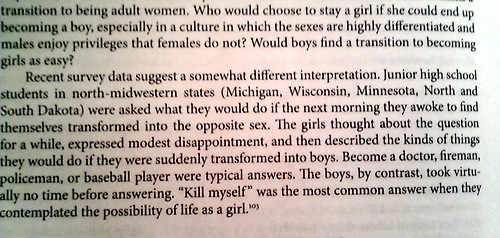
(EDIT: the study referenced in the text can be found here)
this is dumb. if i turned into a boy, the only thing that would change is that i would have a dick and no more boobs the end.
and this reminds me of how the entire last season of sailor moon was never aired on tv in the US because it had guys who transformed into girls. I guess that was too confusing and weird for all the little hyper masculine american boys who would rather kill themselves than be a girl.
oh and I also find it funny because americans are always so quick to judge asian societies as being sexist and backwards in comparison to the west, which really shows that westerners completely lack self-awareness. anime has crossdressing characters and effeminate guys all the time and it's totally acceptable for straight male celebrities to flaunt themselves at the camera and wear guyliner and shit, which is stuff that freaks americans out! and in the us, stuff like that is automatically associated with homosexuality because of course straight guys can't be even a little effeminate!
and westerners are the ones who have a history of exoticizing asian women and emasculating asian men because of course asian countries are "weaker" and thus more feminine than the strong, masculine western countries. and yet americans still honestly think that they respect women so much more than asians do. it's such bs.
i swear, one day i'm going to get so angry over this shit that i'll grow 100x my normal size and destroy new york!!
